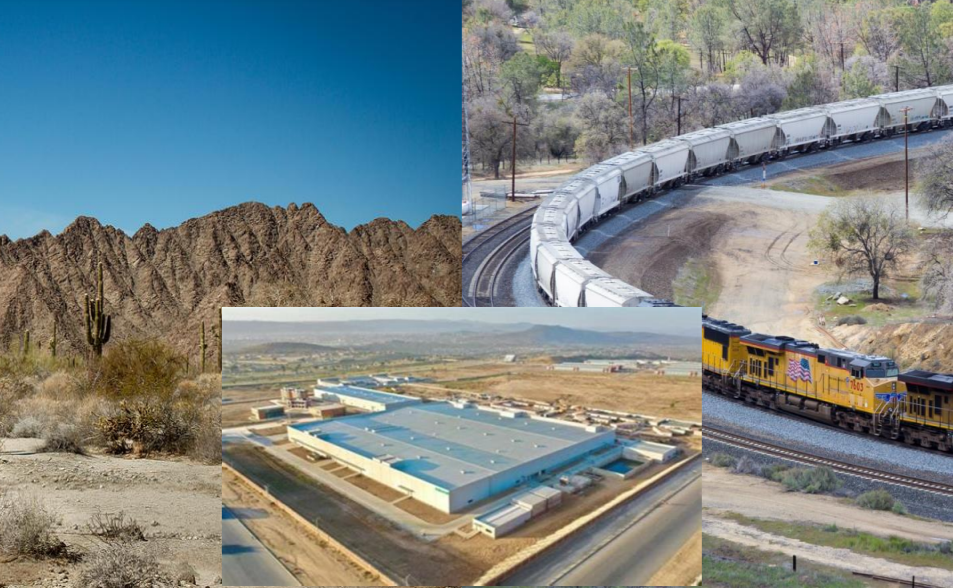

Infrastructure Certainty for the Next Generation of Manufacturing in the Desert Southwest
As heavy manufacturers and steel producers evaluate locations for future growth, the conversation has shifted beyond incentives and short-term cost advantages. Today’s site selection decisions are increasingly driven by infrastructure certainty, energy reliability, logistics efficiency, and access to critical resources—all over a multi-decade horizon.
In the Desert Southwest, Greater Yuma, Arizona is emerging as a region intentionally building this foundation.
Asher Inland Port: Scale, Rail, and Resources in One Location
At the center of Yuma County’s industrial strategy is the Asher Inland Port, a purpose-built, rail-centric industrial site designed to support large-scale manufacturing, logistics, and food processing operations.
The site encompasses more than 565 acres of contiguous, shovel-ready industrial land, allowing for flexibility in layout, future expansion, and multi-phase development—an increasingly rare asset in the western United States.
Asher offers direct Union Pacific Railroad (UPRR) access, including the ability to accommodate unit train service and intermodal operations. This level of rail integration enables efficient inbound raw material delivery and outbound finished product movement, with direct connections to the Ports of Los Angeles and Long Beach, as well as inland rail hubs across the Southwest.
Equally important for resource-intensive manufacturing, the Asher Inland Port includes secured water rights sufficient to support high-demand industrial users. In an era when water availability is a growing constraint across the West, this long-term certainty is a critical differentiator for steelmaking, advanced manufacturing, and processing operations.
Infrastructure Certainty for the Next Generation of Manufacturing in the Desert Southwest
- Foreign Trade Zone (FTZ) status for import/export efficiencies
- No PM-10 regulations or CEQA requirements, unlike many California locations
- Lower labor costs and a pro-business regulatory environment
- On-site infrastructure, including power, fiber, natural gas, and pipeline access
Together, these attributes position Asher not simply as an industrial park, but as a strategic inland port designed for rail-dependent, large-footprint industry.
Energy Infrastructure Designed for Reliability and Scale
Complementing Asher’s logistics and land advantages is a coordinated investment in energy infrastructure that supports both traditional and next-generation power needs.
The proposed Yuma Pipeline Project will add a 90-mile, 30-inch natural gas pipeline capable of delivering up to 800 million cubic feet per day. Running from Quartzsite through Yuma and into Mexico, the project strengthens regional energy integration and ensures long-term, reliable natural gas supply for industrial users and power generation.
At the same time, the planned Pioneer Clean Energy Center adds grid flexibility and resiliency. The project combines 300 megawatts of solar generation with 1,200 megawatt-hours of battery storage, capturing solar energy during the day and dispatching it during peak demand periods. Scheduled to begin construction in September 2025, the facility enhances reliability while using minimal water resources—an important consideration in arid regions.
Together, these investments provide energy diversity and redundancy, reducing exposure to volatility while supporting energy-intensive operations that require consistency and scale.
A Region Planning for Long-Term Industry
Rather than pursuing isolated projects, Greater Yuma is intentionally developing an integrated industrial and energy corridor—where rail, land availability, water security, and energy infrastructure align to support long-lived industrial assets.
For manufacturers evaluating where to place the next generation of facilities, Yuma offers a rare combination: room to grow, infrastructure already in place, and the ability to operate without the regulatory and logistical friction common in coastal markets.
As supply chains evolve and manufacturing footprints are reassessed, regions that plan for decades—not cycles—will be best positioned to support the industries that power the U.S. economy.